
Kala Early Learning Library
My First Words · Book 10
First Words That Matter: 20 Core Words for Late Talkers and Early Starters | Ages 18 Months to 3 Years
Twenty words a toddler can use to ask, refuse and be understood today.
A child can know twenty animals and still have no way to say help, stop, more or done. This book teaches twenty words chosen for how often a young child actually needs them, one word per spread, with a real photograph, a gesture and three graded phrases.
Ages 1 to 3
Hardcover and Kindle on Amazon
78 pages
Look Inside available
Available on AmazonAmazon is the purchase source of truth for current price, format, stock, shipping, delivery, and returns.
View this book on Amazon
Why families open this book
Most first words books teach a child to name the world. This one teaches a child to act in it.
A toddler can know twenty animals and still have no way to say help, stop, more or done. Those are the words that end a meltdown, ask for a second helping, stop a hand that is about to grab. First Words That Matter teaches twenty of them, explicitly, one at a time, with a real photograph of a real child using the word in a real moment.
Who this book is written for
Most children absorb language without anyone teaching it. Some do not, and some do it far earlier than anyone expects. This book is built for both of those situations rather than the middle.
- Children whose language is arriving slowly. Late talkers, children on a waitlist for a speech evaluation, and children already working with a speech-language pathologist who need something structured to practise at home between sessions.
- Families who want to begin early and deliberately. Households that value explicit, sequenced early learning and would rather teach the useful words on purpose than wait and hope.
- Bilingual homes and later starters. A small, high-frequency core vocabulary is the fastest route into a new language for a young child.
Why these twenty words
They are function words, not labels. More, help, go, stop, up, no, want, my, in, out, eat, drink, sleep, come, open, done, again, mine, please, uh-oh. A short list of high-frequency words like these carries an outsized share of everyday communication, which is why they are worth teaching directly instead of leaving to chance.
Every word is paired with a gesture, so a child who cannot yet produce the sounds still has a way to be understood today. Gesturing does not delay speech. It gives a child a reason to keep communicating while speech catches up.
What is on the page
- One word, one large photograph of a child genuinely using it, one colour field. No clutter, no competing detail.
- Sounds like pronunciation, in plain spelling.
- Say it like this: three graded phrases, from the single word to a short sentence, so you can pitch the model just above where your child currently is.
- A gesture cue you can make with your own hands while you say the word.
The part that does the actual work
The book is not the intervention. You are. A page teaches nothing on its own, and no child learns more from a photograph. What teaches is an adult sitting close, saying the word warmly, making the gesture, then waiting and treating whatever comes back as an answer worth having.
This is why the format is deliberately spare. The book removes the guesswork about what to say and when, so your attention can go where it belongs, which is on the child in front of you. Interested, unhurried companionship is the ingredient that turns twenty printed words into twenty usable ones.
Format
Twenty word spreads, real photography throughout, high-contrast type, ages roughly 18 months to 3 years. Also useful past that age for any child still building functional everyday language.
Part of the My First Words collection from the Kala Early Learning Library.
An educational resource for families and the adults who read beside a child. It is not speech therapy, a diagnostic tool, or a substitute for individual guidance from a speech-language pathologist. If you have concerns about your child's language, an evaluation is worth having early, and this book sits comfortably alongside one.
Why this book
A book should have a reason to exist.
Most first words books are lists of nouns. A child can know twenty animals and still have no way to say help, stop, more or done. Families raising a late talker, and families who would rather teach deliberately than wait, need the useful words taught directly.
Twenty high-frequency function words, one per spread, each paired with a gesture and three graded phrases, so the adult beside the child always knows what to say and how far to stretch it.
The word more can change what happens next. It keeps the snack coming, restarts the game, asks for one more turn. First Words That Matter teaches the small set of words that carry most of a young child's day, and it teaches them explicitly, because some children do not pick them up on their own and some families would rather not leave it to chance.
Function words, not labels. Chosen for how often a child needs them, not how easily they photograph.
A gesture with every word, so a child who cannot yet make the sounds still has a way to be understood.
Three graded phrases per word, so a grown-up can pitch the model just above where the child is now.
Look inside
See what you are actually getting.
Preview imagery is drawn from this title’s verified book media. No substitute pages and no invented interiors.
Inside the book
More than a topic. A designed reading experience.
The details below come from this title’s approved product content.
Most first words books teach a child to name the world. This one teaches a child to act in it.
A child can know twenty animals and still have no way to say help, stop, more or done. This book teaches twenty words chosen for how often a young child actually needs them, one word per spread, with a real photograph, a gesture and three graded phrases.
Four things happen on every single spread
A real child mid-moment, a gesture your child can use before the sounds arrive, three phrases graded from one word to a short sentence, and then a five second pause where your child gets a turn.
Who this book is for
A child whose language is arriving slowly and a family who wants something concrete to do at home. A family who would rather teach the useful words deliberately than hope they arrive. A bilingual home, where the same twenty words carry across both languages.
Twenty words, spread across an ordinary day
These twenty words show up dozens of times before lunch, which means the practice is already built into your day. You are not adding a lesson. You are naming what is already happening, at the moment it happens, and leaving room for an answer.
The part that does the actual work
The book is not the intervention. You are. Say the word warmly when it is genuinely useful, make the gesture, then pause and treat whatever comes back as an answer worth having. This book is not speech therapy or a substitute for guidance from a speech-language pathologist.
Continue the path
One book can open the next question.
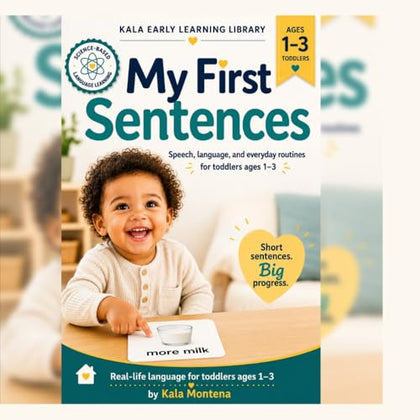
Read next
My First Sentences: Everyday Phrases for Toddlers Ages 1 to 3
Continue with the next logical book in this learning path.
See the next book → First Words: The Teaching Edition | Babies & Toddle...
 Everyday ABCs: Letters, Sounds & Familiar Words
 My First Shapes: Real-Photo Shape Learning for Todd...
 My First Sentences: Everyday Phrases for Toddlers A...
 My First Sentences: Everyday Routines for Toddlers ...
 My First Words Series 2: Real-Photo Vocabulary for ...
 My First Numbers: Real-Photo Number Learning for To...
Real book contentProduct copy and previews are tied to the actual title.
Age guidance, not assessmentKala resources are educational and do not diagnose or predict an individual child.
Amazon is purchase truthAmazon controls current price, stock, shipping, delivery, and returns for Amazon titles.