
A toddler can sing or recognize letters without yet connecting those symbols to spoken words and sounds. Families need an alphabet experience that is concrete, brief, and easy to share without turning early literacy into drilling.
Kala Early Learning Library
My First Words · Book 8
Everyday ABCs: Letters, Sounds & Familiar Words
Connect the letter to a word your child already understands.
Ages 1 to 3
76 pages
Look Inside available
Available on AmazonAmazon is the purchase source of truth for current price, format, stock, shipping, delivery, and returns.
View this book on Amazon
Why families open this book
Knowing the alphabet song is not the same as beginning to understand what letters do.
Everyday ABCs gives toddlers and young preschoolers a gentler bridge from familiar words to letters and early sound awareness. Each page starts with something concrete, such as Apple, Ball, or Cat, then connects that word to its letter, an easy sound cue, another familiar word, a simple tracing opportunity, and one grown-up prompt.
Why this book exists
Early alphabet books can become a race to memorize 26 symbols. This book slows the experience down. A letter is introduced through a word a child can understand, a sound they can hear and imitate, and a small interaction they can share with an adult.
What the child gets
- Clear uppercase and lowercase letter exposure
- Familiar keyword anchors
- Simple early sound play
- Another word beginning with the same letter
- Low-pressure tracing exposure
- Conversation prompts for the grown-up
The goal is not perfect pronunciation, handwriting, or recitation. It is to make letters feel connected to spoken language and the child’s real world.
Part of the My First Words collection.
Why this book
A book should have a reason to exist.
Familiar words anchor each letter, then a simple sound cue, another example word, tracing exposure, and one parent prompt create a repeatable first step toward letter-sound awareness.
Apple makes A less abstract. Ball gives B something a child can picture. Cat gives C a word that may already exist in the child’s spoken world. Everyday ABCs starts from that familiarity and gently adds the symbol and sound, so the alphabet becomes part of language instead of a separate memorization task.
Familiar words make abstract letter symbols easier to connect to meaning.
Sound cues invite phonological awareness without demanding perfect pronunciation.
Tracing and parent prompts add interaction without turning the book into a worksheet.
Look inside
See what you are actually getting.
Preview imagery is drawn from this title’s verified book media. No substitute pages and no invented interiors.
Inside the idea
Designed for the moment you are reading together.
A clear reading rhythm
Each letter page pairs uppercase and lowercase forms with a familiar keyword, an easy sound cue, another word beginning with the same letter, a small trace-the-letter area, and a parent prompt that can extend the page into conversation.
Something worth noticing
Letters, familiar words, beginning sounds, visual letter forms, early tracing, and the idea that the same sound can begin more than one word.
Useful without pressure
Say the keyword naturally, emphasize the beginning sound briefly, then move on. If the child wants to trace, let them. If they only point to the picture or say the word, that is still useful participation. Letter learning does not need to become a performance.
Continue the path
One book can open the next question.
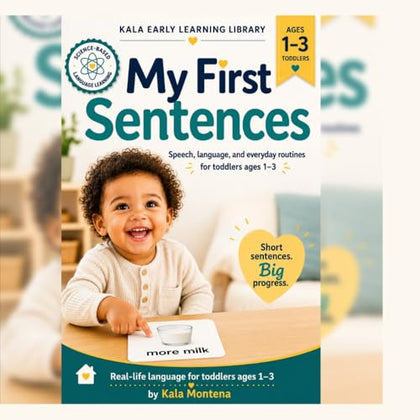
Read next
My First Sentences: Everyday Phrases for Toddlers Ages 1 to 3
Continue with the next logical book in this learning path.
See the next book → First Words: The Teaching Edition | Babies & Toddle...
 First Words That Matter: 20 Core Words for Late Tal...
 My First Shapes: Real-Photo Shape Learning for Todd...
 My First Sentences: Everyday Phrases for Toddlers A...
 My First Sentences: Everyday Routines for Toddlers ...
 My First Words Series 2: Real-Photo Vocabulary for ...
 My First Numbers: Real-Photo Number Learning for To...
Real book contentProduct copy and previews are tied to the actual title.
Age guidance, not assessmentKala resources are educational and do not diagnose or predict an individual child.
Amazon is purchase truthAmazon controls current price, stock, shipping, delivery, and returns for Amazon titles.
Pricing
Pricing on request
This title is available to buy on Amazon, where current price, format and delivery are shown. For school, nursery, library or wholesale orders, please get in touch and I will send pricing and availability for the titles you need.