
Wild-animal books can collapse survival into speed, danger, and predator-versus-prey drama. That misses the quieter intelligence inside hunger, tracking, timing, adaptation, endurance, memory, signaling, and knowing a landscape well enough to stay alive.
Kala Early Learning Library
Animals · Book 6
Animals: Wild
Wildness is a form of knowledge acquired because an animal needs it.
Ages 4 to 6
Digital Edition
76 pages
Look Inside available
Verified Amazon link coming soonKala does not send families to an unverified marketplace listing.
Return to the Library
Why families open this book
Wildness is not a label for an animal. It is knowledge earned because survival requires it.
Animals: Wild is a real-photo science book for children ages 4 to 6 about what animals know when there is no bowl filled for them, no safe enclosure, and no human plan arranging the day.
A wolf can continue hunting after long hunger. A gazelle can signal strength to a predator. Herds change landscapes. Long-lived animals carry histories in bodies and behavior. The book explores survival not as a dramatic chase scene, but as a system of hunger, tracking, adaptation, instinct, endurance, memory, risk, and response.
For the child who asks what animals do when no one is taking care of them
Sixteen words move through real behaviors and the mechanisms behind them. Each encounter ends with a wonder question, giving the child room to think about forms of knowledge humans can study but never fully experience from inside the animal.
- Real wildlife photography
- 16 words about survival and wild behavior
- Predator, prey, tracking, endurance, instinct, adaptation, and ecology
- Caregiver science notes
- Open questions that keep wild animals from becoming simple heroes or villains
Animals, Book 6 of 8. Every animal knows something you don’t.
Why this book
A book should have a reason to exist.
Sixteen words use real animals and specific survival behavior to show children that wildness is not chaos. It is a set of finely tuned responses to a world that does not arrange itself around the animal.
A wild animal cannot ask the world to become easier. It has to know where to go, what to notice, when to move, what to fear, what to endure, and when a signal from another animal changes the equation. Animals: Wild lets children meet survival as knowledge rather than spectacle.
Reframes wild animals around survival knowledge, not only dramatic predator scenes.
Connects behavior such as tracking, signaling, hunger, and endurance to bodies and ecosystems.
Wonder questions help children respect animal solutions that cannot be reduced to human experience.
Look inside
See what you are actually getting.
Preview imagery is drawn from this title’s verified book media. No substitute pages and no invented interiors.
Inside the idea
Designed for the moment you are reading together.
A clear reading rhythm
Every word receives a real photograph, a specific IT DOES THIS behavior, the INSIDE IT body or system that makes it possible, a second photograph, and a YOU WONDER question. The book avoids vague statements such as ‘wolves are good hunters’ in favor of particular behavior worth stopping over.
Something worth noticing
Hunger, tracking, survival, fear, signaling, adaptation, instinct, endurance, movement, predator-prey decisions, seasonal change, and animal memory become a vocabulary for wild life.
Useful without pressure
Resist turning the animals into good and bad characters. Ask what problem each behavior solves. A predator is solving hunger. Prey is solving survival. A signal, track, migration, or change in grazing can become evidence of how one animal’s decisions affect a whole place.
Continue the path
One book can open the next question.
Read next
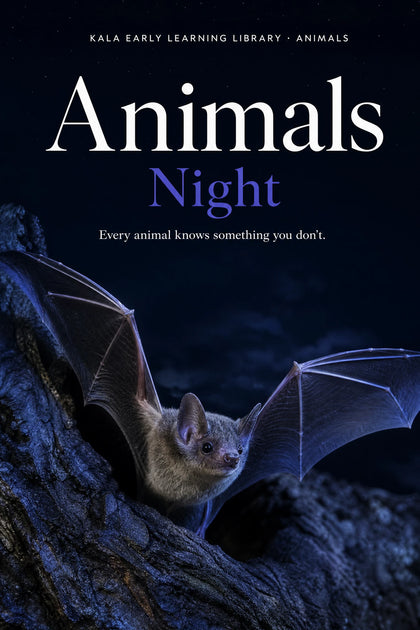
Explore the complete Animals collection →Animals: Night | Digital Edition
Continue with the next logical book in this learning path.
See the next book → Animals: Sea
 Animals: Zoo
 Animals: Sky
 Animals: Pet
 Animals: Jungle
 Animals: Underground
 Animals: Night
Real book contentProduct copy and previews are tied to the actual title.
Age guidance, not assessmentKala resources are educational and do not diagnose or predict an individual child.
Amazon is purchase truthAmazon controls current price, stock, shipping, delivery, and returns for Amazon titles.
Pricing
Pricing on request
For pricing on this title, including school, nursery, library and wholesale orders, please get in touch and I will come back to you with figures and availability.