
Many ocean books stop at naming whales, sharks, fish, and octopuses. A curious child quickly reaches the next question: how can these animals survive pressure, darkness, currents, and a sensory world so different from ours?
Kala Early Learning Library
Animals · Book 1
Animals: Sea
The ocean becomes a different world when you ask how its animals sense, survive, and think.
Ages 4 to 6
Digital Edition
76 pages
Look Inside available
Verified Amazon link coming soonKala does not send families to an unverified marketplace listing.
Return to the Library
Why families open this book
Most ocean animal books tell a child what an animal is. Animals: Sea asks the more interesting question: how can it live there at all?
Created for children ages 4 to 6 and the adults reading with them, this real-photo science book goes beneath familiar labels such as whale, shark, octopus, and fish. It explores the pressure, darkness, sound, movement, hunting, camouflage, and extraordinary senses that make ocean life possible.
A sperm whale carries a body built for the deep. A shark can read electrical signals. An octopus solves problems with a nervous system spread far beyond its central brain. The point is not to make the ocean simpler. It is to show a child that another kind of animal can know the world in a way humans cannot directly experience.
Why this book is different
Each of 16 words unfolds across four pages: a real photograph, the animal’s behavior, the body or mechanism behind it, a second photograph, and a wonder question that does not pretend every mystery has an easy answer.
For the curious child who has outgrown basic animal books
- Real photographs, not cartoon animals
- 16 carefully chosen sea-science words
- Specific animal behavior and mechanisms
- Caregiver notes with deeper scientific context
- Open wonder questions that build curiosity rather than test recall
Animals, Book 1 of 8. Every animal knows something you don’t.
Why this book
A book should have a reason to exist.
Real photographs, precise mechanisms, adult science notes, and open wonder questions turn ocean animals into genuine encounters with other ways of sensing and surviving.
The deeper the ocean becomes, the less human experience can explain it. Light disappears, pressure rises, sound travels differently, and animals solve problems with bodies and senses we do not have. Animals: Sea uses sixteen words to move a child from simply recognizing an animal to wondering what the ocean feels like from inside another kind of body.
Moves beyond animal names into behavior, anatomy, senses, and survival mechanisms.
Real photographs keep strange ocean science connected to real animals in the real world.
Wonder questions preserve curiosity when science does not yet have a complete answer.
Look inside
See what you are actually getting.
Preview imagery is drawn from this title’s verified book media. No substitute pages and no invented interiors.
Inside the idea
Designed for the moment you are reading together.
A clear reading rhythm
Each of sixteen words gets four pages. A real photograph introduces the encounter. IT DOES THIS names the specific behavior. INSIDE IT explains the anatomy, neurology, or chemistry that makes it possible. A second photograph deepens the encounter, then YOU WONDER leaves one open question to hold together.
Something worth noticing
Pressure, depth, darkness, glow, echo, currents, schools, drifting, stillness, hunting, hiding, sensing, tides, surfacing, breathing, and the sea become a vocabulary for how ocean animals meet their world.
Useful without pressure
Read slowly and let the science become conversation. Pause when the child asks how an animal knows, feels, hears, hides, or finds its way. The caregiver notes are there when you want more detail, but the wonder question does not need to be solved.
Continue the path
One book can open the next question.
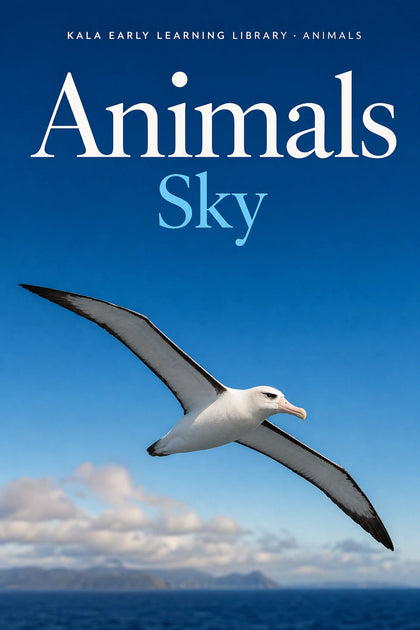
Read next
Explore the complete Animals collection →Animals: Sky | Digital Edition
Continue with the next logical book in this learning path.
See the next book → Animals: Zoo
 Animals: Sky
 Animals: Pet
 Animals: Wild
 Animals: Jungle
 Animals: Underground
 Animals: Night
Real book contentProduct copy and previews are tied to the actual title.
Age guidance, not assessmentKala resources are educational and do not diagnose or predict an individual child.
Amazon is purchase truthAmazon controls current price, stock, shipping, delivery, and returns for Amazon titles.
Pricing
Pricing on request
For pricing on this title, including school, nursery, library and wholesale orders, please get in touch and I will come back to you with figures and availability.